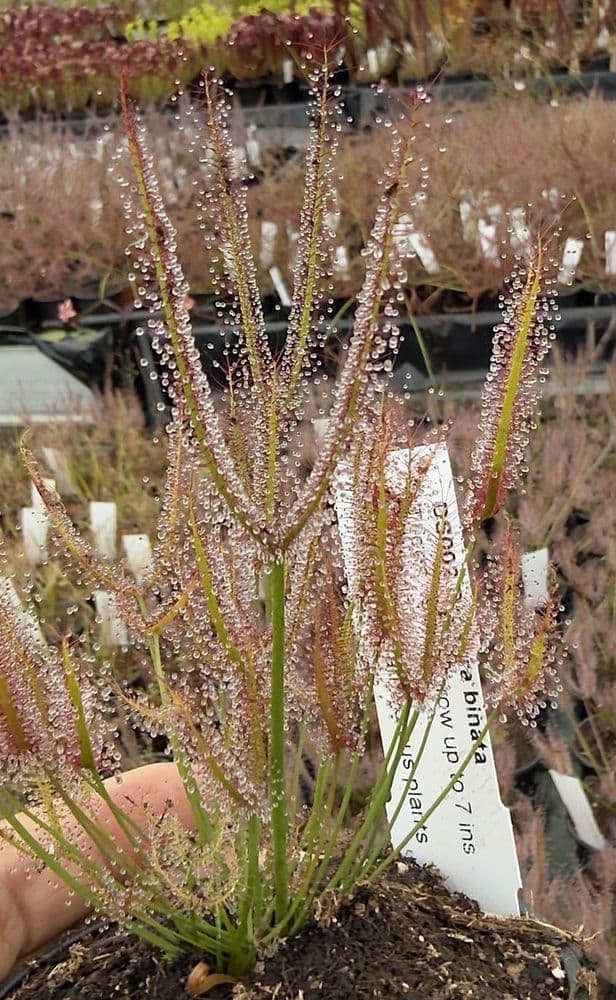
FT001 Venus Fly Trap MEDIUM Dionaea muscipula

-
DESCRIPTION
Venus Fly Trap | Dionaea Muscipula | Carnivorous Plants
Dionaea muscipula – Venus Flytrap
Dionaea muscipula, commonly known as the Venus flytrap, is one of the world’s best-known and most fascinating carnivorous plants. Easy to grow when given the correct conditions, Venus flytraps make excellent plants for beginners as well as experienced carnivorous plant collectors.
Native to a small area of North and South Carolina in the USA, the Venus flytrap naturally grows in open, sunny, nutrient-poor wetland habitats.
Each leaf ends in a hinged trap lined with sensitive trigger hairs. When an insect touches these hairs in the correct sequence, the trap rapidly snaps shut. The plant then digests its prey, absorbing valuable nutrients before the trap eventually reopens.
During spring and summer, a healthy Dionaea muscipula continually produces new traps. Plants grown in strong sunlight develop their best growth and often produce attractive red colouration inside the traps.
Despite its unusual appearance, the Venus flytrap is a hardy temperate carnivorous plant and can live for many years when grown correctly.
How to Grow a Venus Flytrap
Where Should I Grow My Venus Flytrap?
Venus flytraps need plenty of direct sunlight to grow well. A sunny greenhouse, conservatory, bright windowsill or sheltered sunny position outdoors can all be suitable.
The more good-quality sunlight your Venus flytrap receives, the stronger and more colourful the traps are likely to become.
What Water Should I Use for a Venus Flytrap?
Always water Venus flytraps with rainwater, distilled water or reverse-osmosis water.
During spring and summer, stand the pot in a saucer containing approximately 1–2 cm of water. The compost should remain consistently wet and should never be allowed to dry out during active growth.
Avoid ordinary tap water, particularly in hard-water areas, as the dissolved minerals can build up in the compost and damage the plant.
What is the Best Compost for Venus Flytraps?
Venus flytraps require a low-nutrient carnivorous plant compost. Never plant them in ordinary multipurpose compost or compost containing added fertiliser.
For best results, we recommend our COM1 Carnivorous Plant Compost, which is suitable for growing and repotting Venus flytraps and is available to order from our website.
Never add fertiliser or conventional plant food to the compost.
Do I Need to Feed My Venus Flytrap?
No. A Venus flytrap does not need to be hand-fed.
When grown outdoors or in a greenhouse, it will naturally catch small insects. Never feed your Venus flytrap meat or other human food and never apply conventional plant fertiliser.
Do Venus Flytraps Flower?
Mature Dionaea muscipula plants usually produce tall flower stems in spring with clusters of small white flowers.
Healthy, established plants can be allowed to flower. Alternatively, the flower stem can be removed so the plant directs more of its energy into producing leaves and traps.
Do Venus Flytraps Need Winter Dormancy?
Yes. Winter dormancy is an important part of Venus flytrap care.
Dionaea muscipula is a temperate plant rather than a tropical houseplant. As temperatures and daylight levels fall during autumn, growth naturally slows and older traps begin to turn black and die back.
This is completely normal and does not mean your Venus flytrap is dying.
During winter, keep the plant cool, well lit and damp. Growth will resume as temperatures and daylight increase in spring.
When Should I Repot a Venus Flytrap?
We recommend repotting Venus flytraps approximately every 1–2 years, preferably during late winter or early spring before strong new growth begins.
Use fresh specialist carnivorous plant compost such as our COM1 Carnivorous Plant Compost. A reasonably deep pot is beneficial because Venus flytraps can produce surprisingly long roots.
Can I Touch the Traps?
Try not to deliberately trigger Venus flytrap traps with your fingers.
Closing and reopening a trap requires energy, and each individual trap can only operate a limited number of times before it naturally dies and is replaced by new growth.
Is a Venus Flytrap Easy to Grow?
Yes. Venus flytraps are easy to grow once you understand their basic requirements.
Remember these three essentials:
- Plenty of direct sunlight
- Rainwater, distilled or reverse-osmosis water
- The correct carnivorous plant compost
Follow these simple rules and your Dionaea muscipula Venus flytrap can remain healthy for many years, producing increasingly impressive displays of traps each growing season. Plants are sent out ready potted and with a growing guide
Hampshire Carnivorous Plants – specialist growers of Venus flytraps and carnivorous plants in the UK.
-
SPECIFICATIONS
MPN : FT001
genus : Dionaea
Brand : Hantsflytrap
Product Code : FT001
-
REVIEWSWrite A Review
Customer reviews
5 Stars95%4 Stars5%3 Stars0%2 Stars0%1 Stars0%Very helpful and quick customer service.
I had a slight accident with purchasing, and it was dealt with very quickly, i ended up changing my mind 3 times and it got sorted out very quick. I appreciate the help very much and i will be looking to purchase in the close future.
Sammy L | | August 2024
Awsome Verified Purchase
My first ever flytrap always been fascinated by these plants with plenty study on these plants I look forward in growing this well the plant arrived in great condition would recommend this awsome company to anyone wanting a fly trap.
I was so impressed I ordered two more plants.
John Maher | Kirkham preston | May 2024
Absolutely Outstanding, I recommend! Verified Purchase
The traps were pre-fed and there were more traps than on the listing photo! There were no dead traps, no rot, overall it was a happy and healthy Venus Flytrap! Recently, over the past few years, I have been obsessed with carnivorous plants, so I finally decided to buy a Venus Flytrap along with the Nepenthes x Ventrata hybrid. These plants along with Hampshire Carnivorous Plants have reached beyond expectation standards! I am very happy.
Paulo | Skipton | September 2023
Product exceeded expectations
I have just started a bog garden. Ordered a venus fly trap from Hampshire Carnivorous Plants with lots of other varieties. I'm very impressed with the quality of what I received. Many thanks.
Richard Hodges | Kensington | July 2022